

『Oil Flow Meter Barrels per Day: Oilfield Upstream Production Measurement Benchmarks』Related information(v cone flow meter|rotary gas meter|gallon meter|gear meter|metal tube rotameter|glass tube rotameter|nutating disk meter|transit time ultrasonic flow meter|wedge flow meter|pd meters|hydraulic flow meter|ultrasonic water flow meter|water flow meter|air flow meter|magnetic water flow meter|oxygen flow meter|gas flow meter|argon flow meter|air velocity meter|gasoline flow meter|fuel flow meter|ultrasonic water meter|digital water meter|nitrogen flow meter|solid flow meter|Oxygen tank flow meter|digital water flow meter|diesel fuel flow meter|steam flow meter|02 flow meter|compressed air flow meter|oil flow meter|liquid flow meter)
Oil Flow Meter Barrels per Day: Oilfield Upstream Production Measurement Benchmarks
Quick Answer: Flow meters in upstream oil are picked by well output in barrels per day (BPD), not by guesswork. A 500 BPD well with viscous crude works best with a Coriolis meter sized for 0–10 m³/h, while a 10,000 BPD high-water-cut producer needs an inline electromagnetic meter with 4–20 mA HART output to the SCADA. Send your BPD number, pipe diameter, and fluid composition, and we will size the right meter.
Why BPD Rules Flow Meter Selection on the Wellhead
Upstream measurement lives and dies by one number: barrels per day. Reservoir engineers log it, production accountants invoice from it, and lease operators watch it on morning rounds. A flow meter that cannot hold accuracy at 150 BPD on a marginal stripper well costs a small operator in Texas or Alberta real money. At the same time, a 15,000 BPD gusher in the Middle East demands a completely different meter bore and signal processing speed.
Most engineers skip this part: BPD is not a stable number. Gas breakout, sand, wax, and varying water cut swing the flow profile minute by minute. Choosing a meter by pipe size alone without a BPD target leads to meters running in the low end of their turndown and drifting. We always ask for the expected minimum, normal, and maximum BPD before recommending a meter model.
Positive Displacement Meters for Sub-300 BPD Wells
For single-well leases producing under 300 BPD, oval gear flow meters still hold a strong place. A viscous crude at 35 °C with 200 cP pushes a 40 mm (DN40) oval gear meter easily and delivers repeatability within 0.2%. We have supplied these to onshore fields in Argentina where operators batch-measure 50 to 200 BPD of heavy oil straight from the heater-treater. The meter pairs with a local register or a pulse output to an RTU. Because there is no minimum conductivity requirement, the oval gear design ignores the water-cut phase and just counts volume.
Here is the thing: oval gear meters clog when sand or paraffin shows up. A strainer on the inlet is not optional. In practice, operators in Indonesia install a 300-micron Y strainer and clean it every two weeks. Without that step, the meter jams and BPD data goes missing for a whole shift.
Coriolis Meters for High-Accuracy Crude Sales at 500–5,000 BPD
Once a lease crosses the 500 BPD line and the crude enters a sales pipeline, a Coriolis mass flow meter becomes the benchmark. It reads mass flow, density, and temperature simultaneously, so you get net oil BPD corrected for temperature and BS&W without separate instruments. A customer in Oman runs a Silver Automation Instruments Coriolis meter on a 4-inch (DN100) line flowing 3,500 BPD of 32 °API crude with 0.3% water cut. The meter sends mass flow in kg/h and converts to barrels using live density. Accuracy is ±0.15% of rate, and the meter holds that across a 20:1 turndown.
The connection matters. 4–20 mA HART and RS485 Modbus are standard. On that Oman site, the HART signal feeds a flow computer that corrects for pressure and temperature, then pushes net barrels via Modbus to the DCS. Send us your BPD, operating pressure in bar, and temperature in °C, and we will confirm the right tube geometry and wetted material. ATEX Zone 1 or Class I Division 1 certification is standard on our oilfield Coriolis meters.
Electromagnetic Flow Meters for High-Water-Cut Producers
When water cut exceeds 60%, and the well pushes mostly produced water with oil in slugs, an electromagnetic flow meter on the water leg or the combined stream becomes the practical tool. These meters need a minimum conductivity of 5 µS/cm, which produced brine easily supplies. A DN80 electromagnetic meter handles 4,000 to 8,000 BPD of fluid with a 10 m/s flow velocity limit. We have seen this on customer sites many times: a battery in the Niger Delta feeding a test separator where the electromagnetic meter gives total liquid BPD, and a net oil computer subtracts the water cut from a capacitance probe.
Installation is simple: just meet upstream straight pipe requirements (5D upstream, 2D downstream). Liners in PTFE or PFA resist the H₂S and hot brine. The pulse output goes directly to a PLC or RTU, and the display shows instantaneous BPD. Because there is no moving part, sand erosion is the only long-term worry, and a spool piece replacement fixes it in a two-hour shutdown.
Ultrasonic Flow Meters for Large Line Sizes and Custody Transfer
For trunk lines moving 10,000 BPD and beyond, clamp-on or inline multi-path ultrasonic flow me
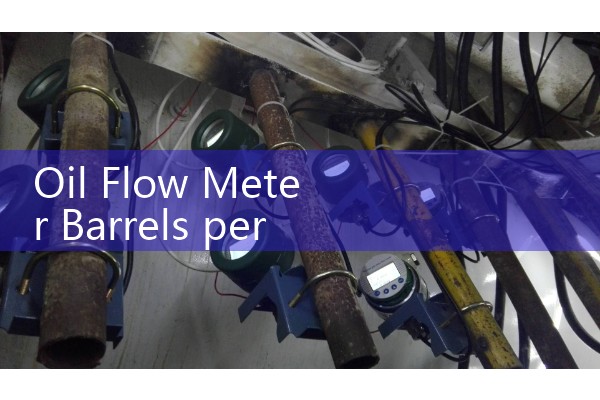
We often supply clamp-on ultrasonic meters for temporary well testing in Australia and Malaysia. The transducers strap onto an existing pipe, measure wall thickness, and give BPD within minutes. No hot work permit, no shutdown. The meter logs data internally and exports via USB, so a production engineer can map a well decline curve across a week without touching the SCADA. If you need a rental or a permanent metering skid, email [email protected] with your pipe OD and wall thickness, fluid type, and BPD range.
How We Benchmark Flow Performance with Local Support
Silver Automation Instruments calibrates every oil flow meter against a master meter traceable to ISO 17025. Wet calibration on crude oil simulates field conditions: viscosity from 5 to 500 cP, temperature from 10 to 120 °C. A small packaging company in Thailand recently ordered a DN25 Coriolis for palm oil derivatives; the meter was tested on a similar-viscosity fluid before shipment. We do the same for upstream crude: mention your typical viscosity when requesting a quote.
Local dealers in Southeast Asia, Africa, and Latin America keep stock of common DN15 to DN100 meters, so delivery times are short. Send an inquiry via Whatsapp at +86-25-52155837 or WeChat +86 15365082610 if you need a price and lead time. For a formal quote, email us at [email protected] with your fluid, BPD range, pipe size, pressure and temperature ratings, and hazardous area requirements. A typical response includes a technical selection sheet and a commercial offer within one business day.
FAQ
How do I convert flow meter readings to barrels per day?
Most oilfield flow meters output volumetric flow in m³/h or L/min. Multiply m³/h by 151 to get BPD approximately. A Coriolis meter gives mass flow in kg/h; divide by density (kg/m³) to get m³/h, then multiply by 151. You can program the local display or SCADA to show BPD directly if you enter the conversion factor. Our meters have user-configurable engineering units.
What accuracy can I expect for wellhead crude measurement?
Oval gear meters deliver ±0.2% of reading on clean viscous crude. Coriolis meters reach ±0.1–0.15% of rate for liquid. Electromagnetic meters average ±0.5% for high-water-cut fluid. Ultrasonic clamp-on meters sit around ±1% to ±2%, depending on pipe condition. Actual field accuracy drops by 0.2–0.5% when gas bubbles or sand are present.
Which flow meter handles sand and solids best?
Electromagnetic meters with an abrasion-resistant liner handle moderate sand without internal obstruction. No moving parts means sand just passes through. Coriolis meters can sustain erosion over time if sand is constant; a duplex strainer on the inlet solves this. Oval gear meters are the most sensitive and require a strainer. In sandy wells in Venezuela, we recommend a 200-micron strainer and an electromagnetic meter if water conductivity is above 5 µS/cm.
Do I need a flow computer with my meter?
If you sell oil based on net standard volume at 15 °C and 0 psig, yes. A flow computer takes the flow meter pulse or HART signal, plus pressure and temperature inputs, and calculates net barrels. Our meters can output directly to an Omni, ROC, or flow computer of your choice. For allocation measurement only, the meter display and 4–20 mA are often enough.
How fast can I get a meter for an urgent well hookup?
Common sizes (DN15 to DN80) in 316L stainless steel are often in stock at our warehouse or at a distributor near the Gulf of Guinea or Southeast Asia. Air freight adds 5–7 days. Call our support line at +86-25-68650347 or message on Whatsapp with your required size and specification, and we will confirm same day. We can also configure a metering skid with mounted valves and a transmitter within two weeks.
For more information on flow meter sizing for your BPD requirement, visit our website flow-meter.com.au or explore flow-meter.com.au for the full product range. Tell a sales engineer your BPD benchmark and we will give you a straight recommendation, not a catalogue list.
 Hot Blog
 Related AD