

『Flow Meter Factor Calculation Guide: Deriving Precise K-Factors for Digital Totalizers』Related information(v cone flow meter|rotary gas meter|gallon meter|gear meter|metal tube rotameter|glass tube rotameter|nutating disk meter|transit time ultrasonic flow meter|wedge flow meter|pd meters|hydraulic flow meter|ultrasonic water flow meter|water flow meter|air flow meter|magnetic water flow meter|oxygen flow meter|gas flow meter|argon flow meter|air velocity meter|gasoline flow meter|fuel flow meter|ultrasonic water meter|digital water meter|nitrogen flow meter|solid flow meter|Oxygen tank flow meter|digital water flow meter|diesel fuel flow meter|steam flow meter|02 flow meter|compressed air flow meter|oil flow meter|liquid flow meter)

Flow Meter Factor Calculation Guide: Deriving Precise K-Factors for Digital Totalizers
Quick Answer: K-factor is the pulse count per engineering unit of flow. A digital totalizer uses this value to convert raw pulses into total volume or mass. To derive a precise K-factor, run a calibration test, divide the total pulse count by the actual volume or mass, and enter the average value into the totalizer.
What Is a Flow Meter K-Factor?
A K-factor is the number of pulses a flow meter emits for one unit of flow. For liquid meters, the unit is usually pulses per litre or pulses per cubic metre. For gas and steam meters, the unit may be pulses per kg or pulses per standard cubic metre. A digital totalizer uses this number to convert raw pulses into total flow. If the value is wrong, the total displayed volume is wrong. That is the core issue.
Different meter types have different K-factor behavior. An electromagnetic flow meter is linear. Its K-factor stays close to 1.000 pulses per litre across a wide flow range. An oval gear flow meter gives more pulses per litre. A DN15 oval gear meter for diesel may produce 150 to 480 pulses per litre. A vortex flow meter may produce 5 to 30 pulses per litre on a DN25 to DN100 line.
K-Factor Formula for Digital Totalizers
The core formula is simple. K = N / V. K is pulses per unit volume. N is total pulse count during the test. V is actual volume passing the meter during the same period.
For mass flow meters, use K = N / M. M is actual mass in kg or tonnes. Silver Instruments configures its Coriolis mass flow meters with a factory K-factor based on real water calibration or national traceability standards.
Here is the thing. A digital totalizer often does the inverse calculation. It takes the incoming pulse total and divides by K. Example: total pulses = 125,000. K = 5.00 pulses per litre. Volume = 125,000 / 5.00 = 25,000 litres. If K is entered as 5.20 by mistake, the totalizer shows 24,038 litres. That is a 3.85 percent undercount.
How to Derive a Precise K-Factor from Calibration
Use a reference standard. A calibrated tank, a master meter, or a weighing scale works for liquid. For gas, use a bell prover or a sonic nozzle. For mass, use a reference Coriolis meter or a weighbridge. Run the flow meter at a stable flow rate. Avoid startup and shutdown periods because unstable flow adds noise.
Collect pulses for a known volume or mass. Do this at three flow rates: low, middle, and high. Calculate K for each point. If the values are close, use the average K. If they spread by more than 1 percent, load a multi-point correction table into the digital totalizer.
Most engineers skip this part. They enter the factory K-factor and trust it. That works for many electromagnetic and Coriolis meters. But not always. We have seen a steam metering loop in Indonesia where the vortex meter was installed 7 pipe diameters downstream of a control valve. The factory K-factor was correct, but flow swirl added a 2.4 percent error. The site fixed it by adding a straightening vane and moving the meter to 15D downstream.
Meter Factor vs K-Factor: What to Enter in the Totalizer
Some calibration certificates show a meter factor instead of K-factor. A meter factor is a dimensionless ratio. If actual volume is 100.4 litres and the meter indicates 100.0 litres, the meter factor is 1.004. You multiply the flow meter reading by this number.
A K-factor is not dimensionless. It has units of pulses per volume or pulses per mass. Many totalizers accept both values, but they use them in different ways. Check the totalizer manual before you enter data. Do not type a meter factor into a K-factor field. A customer in Egypt once did that on a diesel batch controller. The batch error was 4.7 percent. The issue showed up only when t
Typical K-Factor Ranges by Flow Meter Type
Use these as reference points only. Always check the calibration certificate for your specific meter.
Electromagnetic flow meter: 0.005 to 20 pulses per litre, depending on the pulse output setting. Silver Instruments often sets the default to 1 pulse per litre for DN50. For a DN100 meter, the setting may be 0.1 litres per pulse.
Vortex flow meter: 5 to 30 pulses per litre on DN25 to DN100 lines. Gas and steam applications often use K in pulses per m3.
Oval gear flow meter: 100 to 500 pulses per litre for low viscosity liquids. A DN15 diesel meter may output 200 pulses per litre. Viscous palm oil or glucose syrup may require a corrected K-factor at 10 cP, 50 cP, or 200 cP.
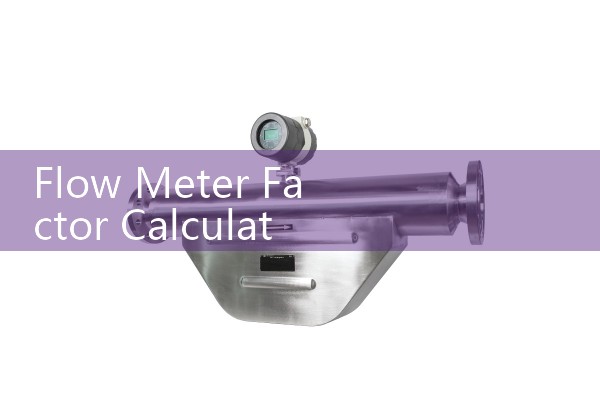
Coriolis mass flow meter: 0.01 to 0.1 pulses per kg. Direct mass pulse output removes density compensation errors for fuel oil, molasses, and chemical mass batching.
How to Enter K-Factor in a Digital Totalizer
Connect the pulse output from the flow meter to the totalizer. Check signal type first. NPN, PNP, reed switch, and active pulse are common. Silver Instruments flow meters can provide dry contact, open collector, or active 24 V pulse output. Match the totalizer input before setting the K-factor.
Then enter the K value in the correct menu. For example, a totalizer in a Malaysian dairy plant uses a microcomputer batch controller. The operator enters 0.995 pulses per litre for a DN25 electromagnetic flow meter. The controller counts pulses, divides by K, and displays litres. The same controller also sends a 4-20 mA HART signal to the PLC.
If the totalizer supports flow rate display, you may need a separate frequency calculation. K-factor still matters for total volume. For flow rate, the totalizer measures pulse frequency and divides by K to get litres per second or m3/h.
FAQ
1. What is the difference between K-factor and meter factor?
A K-factor has units. It is pulses per litre or pulses per kg. A meter factor is dimensionless. You multiply meter factor by the indicated volume to get actual volume.
2. Can I use the same K-factor for different liquids?
Not always. For electromagnetic and ultrasonic meters, K-factor is stable across conductive liquids or clean water. For oval gear and viscosity-sensitive meters, changes in cP can shift the K-factor. Run a new calibration for fluids above 100 cP.
3. How many calibration points do I need for a digital totalizer?
Three points are enough for most linear meters: low, middle, and high flow. For wide turndown or non-linear meters, use a 5-point or 10-point correction table.
4. What happens if I enter the wrong K-factor?
The totalizer will overcount or undercount volume. Errors may appear as inventory loss, wrong billing, or batch inconsistency. A 2 percent error on a 50 m3 batch is 1,000 litres.
5. Does Silver Instruments provide K-factor calibration data?
Yes. Silver Instruments provides factory calibration data with every flow meter. We can also supply site startup support for K-factor verification and totalizer setup. Contact us with your pipe size, fluid, flow range, and totalizer model.
Contact Silver Instruments for K-Factor Support
If you need a reliable pulse output flow meter with correct K-factor data, send us your pipe size (DN), fluid type, flow range (m3/h or kg/h), viscosity (cP), pressure (bar), and temperature (°C). Our engineers will recommend the right meter model and pulse scaling. We support projects in Southeast Asia, Oceania, Latin America, Africa, and the Middle East.
Contact Silver Instruments. Tel: +86-25-68650347. WhatsApp: +86-25-52155837. WeChat: +86 15365082610. Website: flow-meter.com.au.
 Hot Product
 Related AD