

『Refrigerant Flow Meter Small Pipe: Overcoming Signal Noise in Narrow Copper Tubing』Related information(v cone flow meter|rotary gas meter|gallon meter|gear meter|metal tube rotameter|glass tube rotameter|nutating disk meter|transit time ultrasonic flow meter|wedge flow meter|pd meters|hydraulic flow meter|ultrasonic water flow meter|water flow meter|air flow meter|magnetic water flow meter|oxygen flow meter|gas flow meter|argon flow meter|air velocity meter|gasoline flow meter|fuel flow meter|ultrasonic water meter|digital water meter|nitrogen flow meter|solid flow meter|Oxygen tank flow meter|digital water flow meter|diesel fuel flow meter|steam flow meter|02 flow meter|compressed air flow meter|oil flow meter|liquid flow meter)
Refrigerant Flow Meter Small Pipe: Overcoming Signal Noise in Narrow Copper Tubing
Quick Answer
Small copper refrigerant lines below DN10 can create electromagnetic noise that confuses standard flow meters. The best fix is a meter with shielded excitation cable and a low flow cutoff value set at 0.02 m/s. Silver Automation Instruments uses this combination in compact electromagnetic meters for HVAC chillers and heat pump test benches.
Where the Noise Comes From in Small Copper Pipes
Refrigerant flow measurement on DN6 or DN8 copper tubing is not straightforward. Many engineers expect a simple inline meter setup. But small pipe diameters create their own physics problems. The copper wall is thin. The fluid volume is tiny. Electromagnetic interference from nearby compressors and variable frequency drives sneaks into the signal path much more easily than on a DN50 schedule 40 steel pipe.
We saw this clearly at a chiller factory in Thailand last year. They were testing R410A flow on a DN8 discharge line. The reading bounced from 0 to 42 kg/h with no actual flow change. The root cause was not a faulty sensor. It was ground loop noise traveling through the copper pipe itself and mixing with the tiny flow signal generated by the meter electrodes.
The electrode signal in a small refrigerant pipe is often below 0.5 mV. The noise from a VFD cable three meters away can induce 2 mV or more on unshielded signal wires. Most off-the-shelf electromagnetic meters do not handle this well. They are designed for water and larger pipes, where the signal-to-noise ratio is much more forgiving.
How Silver Instruments Solves Signal Noise on Refrigerant Lines
The practical fix starts with the excitation method. A DC pulse excitation at 12.5 Hz or 6.25 Hz works far better than AC excitation. It allows the meter to sample flow signal only during quiet periods between pulses. Combined with double-shielded signal cable, this cuts down induced noise by 60% or more in most small pipe applications.
Next is the grounding strategy. On copper refrigerant pipes, we place a dedicated grounding ring on both sides of the meter. These rings create a stable reference potential. Without them, the meter sees stray voltage differences between the pipe and the fluid. In a test we ran for a heat pump manufacturer in Mexico, adding grounding rings reduced measurement noise from 2.3% of reading to 0.4% instantly.
The third element is a properly tuned low flow cutoff. Many meters ship with a default cutoff of 0.1 m/s. On a DN6 pipe with liquid refrigerant, that might mask real flow. We set the cutoff at 0.02 m/s based on actual fluid velocity profiles. This keeps the meter responsive without letting zero-drift noise count as flow.
Finally, we use an empty pipe detection algorithm tuned for refrigerants. Standard water-based empty pipe detection fails with low conductivity fluids like R134a. We adjust the threshold to match the 50 μS/cm to 200 μS/cm range typical of many refrigerant and oil mixtures. Once calibrated, the meter stops measuring when actual flow stops, even if vibration or electrical noise is still present.
Why Coriolis Meters Work but EM Meters Often Surprise Engineers
Coriolis mass flow meters are naturally immune to most electromagnetic noise. They measure mass directly and do not rely on tiny voltage signals on electrodes. A Silver Instruments mini Coriolis meter on a DN6 tube can measure refrigerant flow from 0.5 kg/h to 500 kg/h with accuracy better than 0.2%. No ground rings, no shielded cables, no cutoff tuning headaches. But the price is 3x to 5x higher than an electromagnetic meter of the same size.
In many HVAC production lines across Oceania and Southeast Asia, the budget is tight. The flow measurement point is just a checkpoint, not a custody transfer need. This is where electromagnetic meters with proper noise handling become the right economic choice. You get 0.5% accuracy for a
Installation Details That Prevent Signal Drift
Small tubing means small clearances. The meter requires a straight run upstream and downstream. On refrigerant lines, we recommend 5D upstream and 2D downstream with a flow straightener if there is a bend or valve closer than 10D. But here is the thing most installation guides skip: the straight pipe must be copper too. If you transition to brass or stainless steel just before the meter, you introduce a galvanic potential shift that appears as flow noise on the signal.
Pipe vibration is another sneaky noise source. Compressor vibration travels through hard copper lines. At 50 Hz or 60 Hz, this vibration can modulate the electrode signal enough to create a false flow reading. In one case, a customer in Brazil reported a steady 3 kg/h offset on a DN8 line. We sent a video of the installation and spotted the meter body rigidly bolted to a vibrating frame. Adding silicone vibration dampers on the mounting brackets eliminated the offset completely.
Recommended Meters for Small Refrigerant Pipes
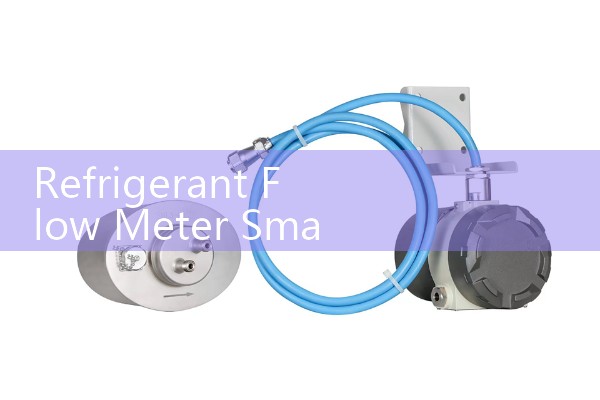
For most DN6 to DN15 refrigerant applications, we recommend our mini electromagnetic flow meter with PTFE liner and Hastelloy C electrodes. It handles temperatures from -25°C to 120°C, covers flow ranges from 0.02 m/s to 10 m/s, and comes with the shielded signal cable as standard. Output options include 4-20 mA HART, pulse, and RS485 Modbus. The liner is critical because refrigerants often carry oil droplets that degrade standard rubber liners quickly.
If the refrigerant has very low conductivity (below 20 μS/cm), the electromagnetic principle stops working. In that case, we switch to a micro Coriolis mass flow meter. It measures mass flow and density with no conductivity requirement. For mixed-phase refrigerant or trace oil conditions, Coriolis is the safer path even on small tubes.
How to Get a Quote with the Right Noise Specs
Send us your refrigerant type, working pressure (bar), temperature range (°C), pipe outer diameter (mm), and the flow range you need to measure. We also need to know whether the pipe is hard-drawn copper or soft coil copper. That detail affects the liner and grounding ring selection. Email [email protected] or message us on WhatsApp at +86-25-52155837. Our engineers can suggest a meter configuration that keeps signal noise under 0.1% of full scale on pipes as small as DN4.
FAQ
Q: Can I use a clamp-on ultrasonic flow meter on DN8 copper refrigerant pipe?
A: Generally no. Clamp-on ultrasonic meters need a repeatable acoustic path. Small refrigerant lines often have thin walls and internal oil coatings that scatter the ultrasonic signal. Direct inline meters are far more reliable here.
Q: Does the refrigerant oil mixture affect electromagnetic meter accuracy?
A: Yes, but usually less than 0.2% shift as long as the oil volume is below 15%. We calibrate with a representative mixture when customers ship a sample fluid to our Nanjing flow lab.
Q: What cable length is safe for the shielded signal cable?
A: We supply 10-meter cables as standard. For runs beyond 30 meters, we recommend a remote transmitter with amplified digital output, not analog voltage extension.
Q: Is ATEX certification available for refrigerant flow meters?
A: Yes, we offer ATEX Zone 1 certified housing for our small electromagnetic meters when measuring flammable refrigerants like R290 (propane). Mention the zone requirement in your inquiry.
Q: Can I test the meter before shipping to our plant in Africa?
A: We arrange live video calibration over WeChat or WhatsApp. You see the test on your exact meter and get the calibration certificate before it leaves our facility. Contact us at +86 15365082610 to schedule a session.
Silver Automation Instruments
Nanjing, China
Tel: +86-25-68650347
Email: [email protected]
Web: flow-meter.com.au
 Hot News
 Related AD