

『Breath Flow Meter: Sourcing Clinical Expiratory Sizing Pulmonary Instruments』Related information(v cone flow meter|rotary gas meter|gallon meter|gear meter|metal tube rotameter|glass tube rotameter|nutating disk meter|transit time ultrasonic flow meter|wedge flow meter|pd meters|hydraulic flow meter|ultrasonic water flow meter|water flow meter|air flow meter|magnetic water flow meter|oxygen flow meter|gas flow meter|argon flow meter|air velocity meter|gasoline flow meter|fuel flow meter|ultrasonic water meter|digital water meter|nitrogen flow meter|solid flow meter|Oxygen tank flow meter|digital water flow meter|diesel fuel flow meter|steam flow meter|02 flow meter|compressed air flow meter|oil flow meter|liquid flow meter)
Breath Flow Meter Sourcing: Clinical Expiratory Sizing and Pulmonary Instrument Selection
Quick Answer: Silver Instruments supplies industrial flow meters for gas lines, test benches, and calibration rigs used with clinical expiratory and pulmonary instruments. If you need a breath flow meter or a gas flow meter for a ventilator test bench, send your flow range in L/min, tube size in mm or DN, gas type, and output signal. We answer sizing questions within 24 hours.
This guide covers sourcing a breath flow meter for clinical expiratory sizing and pulmonary instrument work. We focus on industrial grade devices used by equipment builders, service teams, and test laboratories. We do not sell patient worn sensors or medical consumables.
Know the Difference Between a Patient Sensor and a Test Bench Meter
Expiratory flow measurement in a pulmonary instrument is not the same as measuring water or fuel oil. Gas density is low. Flow rates can swing from 0 to 600 L/min in less than one second. Pressure drop must stay below 0.5 kPa in many test loops. Most engineers skip this part. They choose a flow meter with a large dead volume. That creates a slow response. In practice, a patient connected expiratory sensor is often a low dead space differential pressure element or a hot wire anemometer. An industrial flow meter is different. It works best on the gas supply line, the calibration rig, or the test bench. We have seen this on customer sites many times.
Buyer Checklist for a Breath Flow Meter
Start with these numbers. Flow range in L/min. Gas type. Tube inner diameter in mm or DN. Gas temperature in °C. Inlet pressure in kPa. Output signal. Power supply. For clinical expiratory sizing, most teams ask for 0 to 300 L/min or 0 to 600 L/min. A common output is 4 to 20 mA or RS485 Modbus. Some pulmonary instrument builders need a 0 to 5 V output for data loggers. Do not skip response time. A breath flow meter for a spirometer test bench should settle fast enough for your waveform. Many test benches log at 50 to 100 Hz. Check the sensor response before you buy. Many industrial flow meters are too slow if they are not specified for gas.
Flow Meter Types We Supply for Pulmonary Test Lines
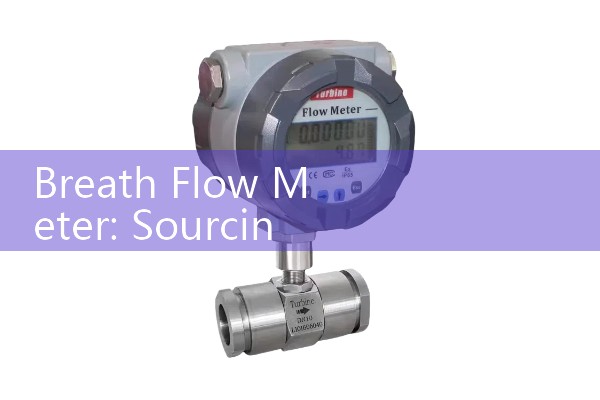
Thermal mass flow meters are strong for dry air, oxygen, and nitrogen lines. They measure mass flow directly. They work well from 0 to 300 L/min with an accuracy of ±1.5 percent of reading. Pressure drop stays low. We supply thermal mass flow meters with 4 to 20 mA HART, RS485, and a local display. For wet exhaled breath with high humidity, a thermal mass meter reads mass flow but may need a condensate trap. You have to plan for moisture. Ultrasonic flow meters also work for gas, but their minimum flow cutoff can be too high for low expiratory flow. Coriolis mass flow meters are rarely used for breath flow. They are too heavy and cost too much for a 10 mm breathing tube. So focus on thermal mass flow meters for gas lines and test benches.
Specific Applications We Have Supported
Last year a ventilator service team in Jakarta asked for a 0 to 300 L/min air flow meter with 4 to 20 mA output. They used it on a calibration rig for
Sizing Parameters for Clinical Expiratory Sizing
Send us these values when you ask for a quote. Flow range in L/min. Gas type. Pipe or tube size in mm. A 12 mm bore is close to DN10. A 19 mm bore is close to DN15. The exact fitting standard matters. Operating pressure in kPa. Temperature in °C. Output signal type. Power supply voltage. In some cases the meter must fit into a portable case. In other cases it is mounted in a 19 inch rack. Tell us if the gas is dry or humid. Tell us if the flow is bidirectional. Many expiratory tests reverse flow for a short pulse. A unidirectional meter will clip that signal. We can supply bidirectional thermal mass flow meters. Accuracy, response time, pressure drop, and cost all matter. But do not assume a medical certificated sensor is the same as an industrial meter. Patient connected clinical instruments need a medical grade sensor with the right approvals.
How to Get a Quote from Silver Instruments
Tell us your flow range in L/min, gas type, tube inner diameter in mm, pressure in kPa, temperature in °C, and output signal. We will recommend a flow meter and send a quote. You can reach us by phone at +86-25-68650347. For WhatsApp use +86-25-52155837. WeChat is +86 15365082610. We answer sizing questions within 24 hours for Southeast Asia, Australia, Latin America, Africa, and the Middle East.
FAQ
Can Silver Instruments supply a breath flow meter for patient connected spirometers?
No. We supply industrial grade flow meters for test benches, calibration rigs, and medical gas lines. Patient connected sensors need medical approvals that fall outside our standard product line.
What flow range should I specify for a ventilator test rig?
Most ventilator test rigs need 0 to 300 L/min or 0 to 600 L/min. For neonatal testing specify 0 to 30 L/min. For adult expiratory flow 0 to 600 L/min covers most cases.
Which output signal works best for pulmonary instrument data logging?
4 to 20 mA is common for PLC and control systems. RS485 Modbus is better for digital data logging. Some lab systems use 0 to 5 V. We can configure all three on thermal mass flow meters.
Can the flow meter handle humid exhaled breath?
Yes, but you need a condensate trap and a meter rated for wet air. Thermal mass flow meters read mass flow in humid gas, but liquid water droplets can damage the sensor if there is no upstream trap.
What is the typical delivery time for a customized gas flow meter?
Standard thermal mass flow meters ship in 2 to 3 weeks. Custom tube fittings or special ranges may take 4 to 6 weeks. We confirm the delivery date with every quote.
 Hot Blog
 Related AD