

 Current position > News detail
『Refrigerant Flow Meter High Pressure: Structural Engineering Rules for Transcritical Media』Related information(v cone flow meter|rotary gas meter|gallon meter|gear meter|metal tube rotameter|glass tube rotameter|nutating disk meter|transit time ultrasonic flow meter|wedge flow meter|pd meters|hydraulic flow meter|ultrasonic water flow meter|water flow meter|air flow meter|magnetic water flow meter|oxygen flow meter|gas flow meter|argon flow meter|air velocity meter|gasoline flow meter|fuel flow meter|ultrasonic water meter|digital water meter|nitrogen flow meter|solid flow meter|Oxygen tank flow meter|digital water flow meter|diesel fuel flow meter|steam flow meter|02 flow meter|compressed air flow meter|oil flow meter|liquid flow meter)
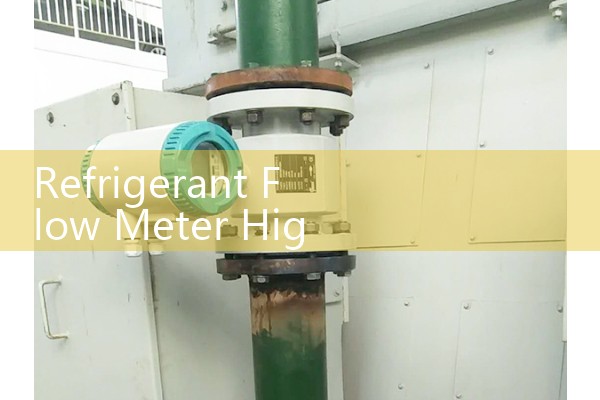
Refrigerant Flow Meter High Pressure: Structural Engineering Rules for Transcritical Media
Quick Answer: High pressure refrigerant flow meters working with transcritical CO2 (R744) need a fully welded body, no gaskets, and a design pressure of at least 130 bar at 120°C. Coriolis mass flow meters and certain positive displacement meters survive these conditions when their structural engineering follows a few non negotiable rules. If you skip these rules, small leaks turn into big safety events within weeks.
Why Standard Flow Meters Fail in Transcritical Refrigerant Lines
Most general purpose flow meters are built for low pressure water or oil. Their housing bolts, O-ring grooves, and sensor welds fail fast when you push CO2 above its critical point (31°C, 73.8 bar). In a transcritical refrigeration rack, discharge pressure routinely hits 110 bar to 130 bar. Temperature spikes to 120°C during defrost or heat reclaim. The medium shifts from supercritical fluid to liquid to gas with small changes in pressure drop. A flow meter with a cast body, PTFE liner, or simple threaded end plug can blow out its seals in the first week of a hot summer in Dubai or Western Australia. We have seen this on customer sites many times: a small CO2 leak that nobody notices until the system loses 15% of its charge. Then the whole supermarket rack goes down.
Structural Rule 1: Welded Construction, No Gaskets
For any flow meter installed in a transcritical CO2 line above 80 bar, you need a fully welded measuring section. The pressure retaining boundary must be metal to metal fusion weld. Silver Instruments supplies Coriolis mass flow meters with a dual tube design where all process connections are butt welded to the manifold. There is no O-ring, no PTFE packing, no bolted split housing. This eliminates the most common leak path. For DN10 to DN25 pipe sizes, the meter body material is 316L stainless steel with a minimum wall thickness of 3.2 mm. For DN40 to DN50, we move to duplex stainless steel 2205 to handle higher mechanical stress without adding weight.
Structural Rule 2: Design Pressure and Burst Safety Margin
A standard PN100 (100 bar) rating is not enough. Transcritical CO2 systems push 120 bar to 130 bar on the high side. You need a flow meter with a design pressure of at least PN160, and a burst pressure above 500 bar. Our high pressure Coriolis meters go through a hydrostatic test at 1.5 times the rated pressure at the factory. Each unit ships with a test certificate. In Europe and Australia, installers ask for PED 2014/68/EU compliance. For Southeast Asia, we provide ASME B31.5 refrigeration piping alignment documents. Most engineers skip this part, but if your local inspector catches a meter without the right pressure certification, the project gets stuck for weeks.
Structural Rule 3: Material Toughness at Low Ambient and High Process Temperature
Transcritical refrigeration plants in Canada, Northern China, or Patagonia start up at ambient temperatures of minus 25°C. The same meter handles gas cooler outlet fluid at 100°C to 120°C. This demands impact tested stainless steel. We specify 316L with Charpy V-notch impact values above 27 J at minus 40°C. Standard 304 stainless gets brittle too fast. For the electronics housing, we use a separate cast aluminum enclosure with an IP67 rating, thermally decoupled from the pipe. There is a PT100 sensor embedded in the meter tube wall. The transmitter uses this data for real time density compensation. In practice, this means the same meter gives a mass flow accuracy of ±0.1% of rate from minus 30°C liquid to 120°C supercritical fluid.
Structural Rule 4: Pressure Drop and Mass Flow Measurement Priority
Refrigeration engineers care about pressure drop more than anything else. A flow meter that adds 1 bar of pressure loss at 120 bar eats into the COP of the whole system. Coriolis meters have a slight pressure drop, but they deliver a di
Common Installation Mistakes That Void Your Warranty
First, many technicians install the flow meter right after the gas cooler without a straight pipe run. This creates swirl that kills the zero stability. You need a minimum of 5D upstream and 2D downstream for Coriolis meters. Second, pipe strain. A high pressure pipe expands a lot with temperature. If the flow meter acts as a rigid anchor between two fixed points, the measuring tubes warp. We always ship two flexible support brackets with the meter. Third, mounting orientation. Liquid CO2 can flash into gas if the meter is placed at a high point with no back pressure. Keep the meter in the flooded line with at least 5 bar back pressure downstream. In practice, this means installing it after the receiver, not before.
How Silver Instruments Tests Every High Pressure Refrigerant Meter
Before shipping, each meter passes a helium leak test under vacuum, then a high pressure nitrogen test at 195 bar (1.5x PN130) for 30 minutes. We also run a simulated flow test with a calibrated viscosity oil at 50°C and compare the mass flow reading against a reference scale. The calibration report includes five flow points from 10% to 100% of rated flow. The data is stored in the transmitter, and you can pull it up via Modbus RTU or 4-20 mA HART. For a 25 kg/h flow range on a DN15 meter, the uncertainty is under ±0.05 kg/h.
FAQ
Q: Can I use an electromagnetic flow meter for transcritical CO2?
No. CO2 is not conductive enough. Electromagnetic meters need a minimum conductivity of 5 µS/cm. R744 fluid has almost zero conductivity. Stick with Coriolis or a high pressure oval gear meter if the flow is purely liquid and below 100 bar.
Q: What is the maximum pressure rating you offer for refrigerant flow meters?
Our standard high pressure Coriolis meter is rated PN160 (2320 psi). For special projects, we have supplied welded meter assemblies rated PN250 with a burst pressure over 1000 bar. Send us your maximum expected pressure and temperature, and we confirm the right model.
Q: Do you supply flow meters for subcritical R744 systems too?
Yes. For subcritical CO2 with lower pressure (40-50 bar), we offer oval gear meters and turbine meters with NBR or EPDM seals. But for anything close to the transcritical point, switch to a fully welded meter. We help you draw that line based on your plant location and ambient temperature.
Q: How do I send an inquiry for a high pressure refrigerant flow meter?
Send us your pipe size (DN), operating pressure (bar), temperature range (°C), and flow range in kg/h. You can email [email protected] or reach us on WhatsApp at +86-25-52155837. We usually quote within 8 hours.
Q: Can the flow meter send density and temperature data to my PLC?
Yes. The transmitter outputs mass flow, density, and temperature simultaneously via 4-20 mA HART and Modbus RTU. You can capture all three signals on a single pair of wires.
Send your pressure (bar), temperature (°C), pipe size (DN), and flow range to [email protected]. We reply with a full datasheet and a price based on your region. For urgent requests, call +86-25-68650347 or message us on WeChat: +86 15365082610.