

 Current position > News detail
『Bidirectional Flow Meter Example Example: Sourcing Dual-Stream Process Sizing Models』Related information(v cone flow meter|rotary gas meter|gallon meter|gear meter|metal tube rotameter|glass tube rotameter|nutating disk meter|transit time ultrasonic flow meter|wedge flow meter|pd meters|hydraulic flow meter|ultrasonic water flow meter|water flow meter|air flow meter|magnetic water flow meter|oxygen flow meter|gas flow meter|argon flow meter|air velocity meter|gasoline flow meter|fuel flow meter|ultrasonic water meter|digital water meter|nitrogen flow meter|solid flow meter|Oxygen tank flow meter|digital water flow meter|diesel fuel flow meter|steam flow meter|02 flow meter|compressed air flow meter|oil flow meter|liquid flow meter)
Bidirectional Flow Meter Example: Sourcing Dual-Stream Process Sizing Models
Quick Answer: A bidirectional flow meter must be sized for the highest forward flow and the highest reverse flow. Silver Automation Instruments supplies electromagnetic, Coriolis, and ultrasonic bidirectional meters for dual-stream process lines in chemical, water, food, and marine applications. Send us your pipe size (DN), pressure (bar), temperature (°C), flow range (m3/h or kg/h), and fluid conductivity for a sizing quote.
What a Dual-Stream Process Requires From a Flow Meter
A dual-stream process has two different fluids sharing one line or the same fluid moving in two directions at different times. We see this on CIP return lines in food plants, filter backwash systems in water treatment, and tank loading and unloading skids in chemical terminals.
Most engineers skip this part. They size the meter for the main flow direction and forget the reverse flow range. Then the meter loses accuracy below its minimum velocity or the display shows a negative total that conflicts with the batch record.
In practice, the meter needs two way flow capability. The output should report positive and negative flow with separate totalizers. For liquid lines with conductivity above 5 µS/cm, an electromagnetic flow meter is often the best choice. For low conductivity fluids or mass based batching, a Coriolis meter works better.
Which Silver Automation Instruments Meters Handle Bidirectional Flow
Electromagnetic flow meters are available from DN15 to DN600 with PTFE or rubber liners. They handle reverse flow for water, wastewater, acid, caustic, slurry, and most water based chemicals. Minimum conductivity is usually 5 µS/cm for standard models.
Coriolis mass flow meters are the right tool for dual-stream batching where viscosity changes or where the product is oil, syrup, or liquefied gas. They measure kg/h directly and do not need conductivity. A typical dual stream sizing for a chemical plant in Indonesia used a DN25 Coriolis meter for solvent forward flow and nitrogen purge in reverse. The meter read both directions with one 4-20 mA HART output and a pulse output.
Ultrasonic flow meters can be clamp-on or inline. They work for water and thermal oil where pipe access is limited. Bidirectional ultrasonic meters are common in district cooling plants and desalination plants in the Middle East.
Oval gear flow meters are not usually bidirectional. Some designs tolerate reverse flow for short periods but they do not give accurate reverse total. But we do not recommend them for dual-stream duty unless a bypass and check valve are installed. See our oval gear flow meter for diesel if your application is single direction fuel transfer.
Sizing Model Example for a Dual-Stream Water and Chemical Line
Here is a real sizing case. A food ingredients plant in Thailand has a DN50 line. The process sends sugar syrup at 12,000 kg/h forward and hot water flush at 8,000 kg/h in reverse. Pressure is 6 bar. Temperature is 80 °C. The syrup has conductivity around 400 µS/cm.
We selected a DN50 electromagnetic flow meter with PTFE liner and 316L electrodes. The forward range matched 0.5 to 10 m/s. The reverse flow matched 0.3 to 6 m/s. Because the meter had bidirectional totalizers, the control system recorded prod
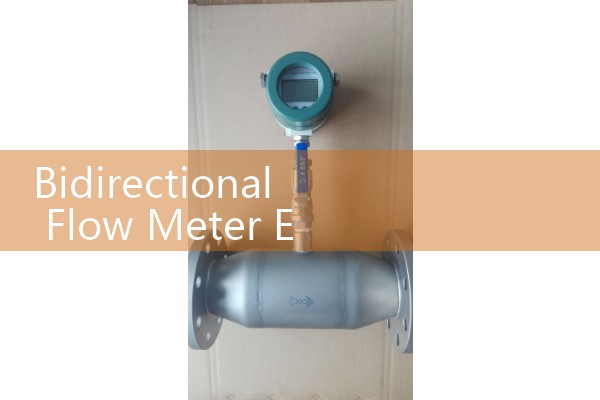
For a second customer in Vietnam, a desalination plant needed seawater flow in both directions through a brine recycle line. We supplied a DN200 electromagnetic flow meter with rubber liner and titanium electrodes. Flow range was 0 to 350 m3/h forward and 0 to 120 m3/h reverse. Output was 4-20 mA HART with Modbus RS485.
Data You Need to Send for a Bidirectional Flow Meter Quote
Do not send only the line size. We need four parameters to size properly. The first is minimum and maximum forward flow. The second is minimum and maximum reverse flow. The third is fluid name, viscosity, and conductivity. The fourth is pressure and temperature range.
Send us your pressure (bar), temperature (°C), pipe size (DN), and flow range. Include the fluid conductivity if you want an electromagnetic meter quote. Our team at Silver Automation Instruments will return a sizing model with model type, liner, electrode, process connection, and output options.
You can reach us by phone at +86-25-68650347. For WhatsApp use +86-25-52155837. WeChat ID is +86 15365082610.
Installation Notes for Two Way Flow Measurement
Install the meter in a straight pipe run. Most electromagnetic and Coriolis meters need 5 diameters upstream and 3 diameters downstream for dual-stream accuracy. If there is a pump on one side and a valve on the other, install the meter away from the valve. A partially open valve creates swirl that makes reverse flow reading unstable.
Because reverse flow totalizers are tricky, we recommend a flow computer or a PLC that can read signed flow values. Do not use a basic counter that only counts positive pulses. It will miss the reverse volume and ruin the batch record.
FAQ
Can a bidirectional electromagnetic flow meter measure low conductivity fluids? No. Standard electromagnetic meters need at least 5 µS/cm. For oils, condensate, or deionized water, use a Coriolis or ultrasonic meter.
What is the minimum reverse flow range I should specify? Most electromagnetic meters measure accurately down to 0.2 m/s. Below that the error increases. If reverse flow is lower than 0.2 m/s, tell us before quoting.
Do I need a special transmitter for bidirectional flow? Yes. The transmitter must support signed output and separate forward and reverse totalizers. Silver Automation Instruments supplies this as standard on electromagnetic and Coriolis models.
Can I use one meter for two different products in the same line? Yes if the meter is sized for the worst case viscosity, flow range, and conductivity. Send both product data sheets. We will check the turndown and Reynolds number.
Which industries buy dual-stream flow meters most often? We supply food and beverage plants, water and wastewater utilities, chemical distribution terminals, desalination plants, and marine fuel transfer systems across Southeast Asia, the Middle East, Latin America, Africa, and Oceania.
Send us your pipe size, pressure, temperature, flow range, and conductivity. Silver Automation Instruments will recommend a bidirectional flow meter with the right liner, electrodes, process connection, and output for your dual-stream sizing model.